Tag Archives: Hebraic Roots

“Are We There Yet?” (Part 7)

“I’m not under the Law. I’m under grace.”

 The above words have slipped off my tongue hundreds of times over the last thirty years, but are they really true?

For sin shall not have dominion over you, for you are not under Law but under grace. (Romans 6:14 NKJ)

When I used to read the word “Law” in the New Testament, I immediately connected it to the Old Testament and assumed that the word “Law” was a bad thing, but of course, I never checked the word out.

The Hebrew word “torah” is translated into our English word “Law” in both the Old and New Testaments. Yet the true meaning of the Hebrew word “torah” is not “Law”, but rather, “instructions or teaching.”

Thus, should I be under the instructions or teaching of God?

“Do not think that I came to destroy the Law [Torah] or the Prophets. I did not come to destroy but to fulfill. (Matthew 5:17)

The word Law (or Torah) in the above verse refers to the Pentateuch or the first five books of the Old Testament: Genesis, Exodus, Leviticus, Numbers, and Deuteronomy. And the word Prophets refers to the books of Isaiah, Jeremiah, Lamentations, Ezekiel, Daniel, and the other prophetic books with Malachi being the last one.

Admittedly, for thirty years, I have looked at the above verse and believed that since Jesus fulfilled the Law or Torah, I did not have to do so. My attitude was — “Thank you Jesus, I can ignore the Law or Torah and its requirements and just follow the red letters in the New Testament.”

I know! I know! I know!

My logic was childish at best because one of my favorite sayings, “Anyone who believes in Me will do the works I am doing and greater ones because I go to the Father,” blows this logic to pieces. You see, one of Jesus’ works was following the Law or Torah.

“…I came not to destroy, but to fulfill.” And surely to ‘fulfill’ means to complete, in the sense of bringing to perfection, not, as Christians have all too often interpreted it, to render it obsolete; but to fulfill in such a way as to perfect a foundation on which to build further. (Christian Jewish Heritage, Western Sussex: Angel Press, 1988, p. 8 via Jewish New Testament Commentary by David H. Stern, Jewish New Testament Publications, 1992, p. 26)

The Apostle Paul wrote:

Does it follow that we abolish Torah by this trusting? Heaven forbid! On the contrary, we confirm Torah. (Romans 3:31 Complete Jewish Bible by David H. Stern, Jewish New Testament Publications, 1998, p. 1408)

Am I there yet? Heavens no! I have many miles to go yet.

So, stay buckled up until next time.

(Continued in Part 8…if you’re interested, the full series to date can be seen here.)
4 Comments

Filed under Christianity, Church, Hebraic roots, Kingdom of God, Prophecy, spiritual warfare

“Are We There Yet?” (Part 6)

“Speak to the children of Israel, saying: ‘The fifteenth day of this seventh month shall be the Feast of Tabernacles (Sukkot) for seven days to the LORD. You shall keep it as a feast to the LORD for seven days in the year…It shall be a statute forever in your generations. You shall celebrate it in the seventh month. You shall dwell in booths for seven days. All who are native Israelites shall dwell in booths, that your generations may know that I made the children of Israel dwell in booths when I brought them out of the land of Egypt: I am the LORD your God.’ ”(Leviticus 23:34, 41-43)

Sukkot (or Feast of Tabernacles) is celebrated on the 15th of Tishri until 22nd of Tishri on the Hebrew calendar, which corresponds to mid-September to mid-October on the Gregorian calendar. The Hebrew word sukkot means hut, tent, or tabernacle.

Today, Jews and Messianic believers construct temporary huts or tents in which meals are eaten throughout the Feast. Some still dwell in them for the full Feast in observance to Leviticus 23:42.

The Feast of Tabernacles is also known as the Feast of Ingathering. From an agricultural standpoint, the Feast represented the end of the crop year with the harvest of grapes and other fruits. It is now time to rejoice.

No whiners during this feast. REJOICE! God loves to party, even more than we do. (Mark Biltz)

Interesting enough, many believe that Jesus was born on the Feast of Tabernacles.

If He was born on the Feast of Tabernacles, why do you think there was no room in the Inn? Thousands of pilgrims. If He was born in December, there would have been all kinds of room. (Mark Biltz)

From a prophetic viewpoint, the Feast of Tabernacles foreshadows the sheltering presence of God over Israel during the Millennial Kingdom. It is also a feast that every nation must keep during this thousand year period or there will be drastic consequences for them.

And it shall come to pass that everyone who is left of all the nations which came against Jerusalem shall go up from year to year to worship the King, the LORD of hosts, and to keep the Feast of Tabernacles. And it shall be that whichever of the families of the earth do not come up to Jerusalem to worship the King, the LORD of hosts, on them there will be no rain. (Zechariah 14:16-17)

This is just a brief overlay of the Feast of Tabernacles. So, if you want to learn more, take the time to watch Mark Biltz’s great video here. You will be blessed for watching it.

(Continued in Part 7…if you’re interested, the full series to date can be seen here.)

2 Comments

Filed under Christianity, Church, Hebraic roots, Kingdom of God, Prayer, Prophecy, spiritual warfare

“Are We There Yet?” (Part 2)


Carol and I walked into our first Hebrew Roots teaching meeting at the Noah’s Ark Christian Bookstore in Temecula, CA. Chauncey Navarro mentioned that his teaching for the evening would be “A Call to Arms” from a Hebrew viewpoint.

We had no expectations, but both of us felt the Lord wanted us to attend the meeting. So, we were eager to learn.

In the first ten minutes, Chauncey used the words: Torah, Pentateuch, Tanakh, and Talmud.

Now, if he would have stopped and asked, “Can anyone tell us what these three terms mean,” I would have slid down in my chair, hoping to hide behind the person in front of me. I had never fully understood these terms.

It turns out the meanings are —

Torah is a Hebrew word that roughly refers to the first five books of Moses, which includes B’resheet (Genisis), Sh’mot (Exodus), Vayikra (Leviticus), B’midbar (Numbers), and D’varim (Deuteronomy). The word Torah is usually translated into the English word Law in most of our English translations, but it more nearly means instructions or directions.

Pentateuch is the Greek translation of the first five books of the Old Testament, and thus our modern Christian translation. Pentateuch means five (penta-) books (-teuchos).

Tanakh is an acronym for TorahNevi’im, and Ketuvim, which mean Law, Prophets, and Writings, respectively. It is the whole Hebrew Bible.

Talmud roughly means the Oral Torah or the rabbinic commentary on how to apply the written texts of the Torah.

Chauncey wove his teaching through the books of Revelation, Daniel, Romans, Ephesians, Isaiah, and others, connecting the Old Testament and the New Testament into one seamless teaching. To him, the New Testament is an addendum to the Old Testament.

Okay, but what did I think when the teaching was over?

I went home and rewrote one of my eBooks, which is published on Amazon. There is no doubt that his teaching opened my eyes to new revelations that I had not seen in my thirty years of studying the Bible.

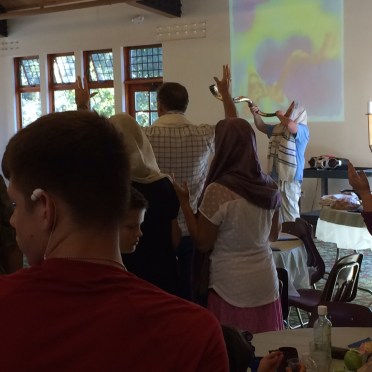
Carol and I finished the week by attending a Feast of Trumpets celebration near Lake Arrowhead, California.

IMG_1780


(Continued in Part 3…and if you are interested, the full series to date can be seen here.)

4 Comments

Filed under Christianity, Church, Hebraic roots, Israel, Kingdom of God, Prayer, Prophecy, spiritual warfare