Tag Archives: End-Times

Prayers for the American Church (10/2/2018)

Christ Church Stellarton

Photograph of Christ Anglican Church, Stellarton, NS. Taken the morning of October 28, 2005

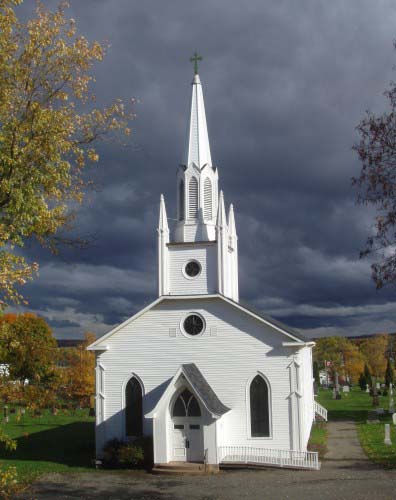
“Do you believe the Bible is the “inspired” Word of God?”

Almost every Evangelical Christians will answer “Yes” to this question and will then quote his or her favorite verses, such as John 3:16, Ephesians 2:8 and Psalm 34:19.

But if you ask Christians whether they believe in Pre-Tribulation Rapture or Post-Tribulation Rapture, 90% of them will answer: “Pre-Tribulation Rapture.”

If you then ask them, “How can you justify your beliefs in light of Paul’s writing in 1 Corinthians 15:52 and John’s words in Revelation 11:15-19?”

Most of the 90% will answer: “Pre-Trib Rapture is what my pastor teaches and I trust him.”

Is this really a big deal?

Well, it’s not a big deal to all of the believers who have died before today. Their beliefs on the rapture did not hinder their faith one way or the other.

Yet, those believers who are alive right now have a chance of being a part of those who are raptured when Christ returns. And if not us, maybe our children or grandchildren will be in the rapture.

So, yes, it’s a big deal, especially because the Apostle Paul wrote:

Let no one deceive you by any means; for that Day will not come unless the falling away comes first, and the man of sin is revealed, the son of perdition (2 Thessalonians 2:3)

I don’t know about you, but I don’t want be deceived and fall away, nor do I want my children or grandchildren to fall away. I want them and myself to be prepared to fight the good fight, finish the race and keep the faith all the way to the end.

There are more than 150 chapters about end-times prophecy in the Bible. That’s over sixty more chapters than the total combined chapters of Matthew, Mark, Luke and John. Thus, as you can see, God has placed an emphasis on the end-times. Shouldn’t we at least  study and prepare ourselves, just in case our theology is wrong?

My prayer today:

Lord, open the eyes of the American church so that they are like the Bereans who searched the Scriptures to discover the truth for themselves rather than like the Thessalonicans who relied on their leaders’ teachings. (Based on Acts 17:10-11)

Join me on Tuesdays to fast and pray for the American church.

4 Comments

Filed under America, Christianity, Church, End-Times, Fasting, Gifts of the Spirit, Kingdom of God, Prayer, Prophecy, spiritual warfare

Churches: Fellowships Without Fellowship (Part 5)

Continuing with Wolfgang Simson’s 15 Theses from his book, House Churches That Change the World:

5. The church has to become small in order to grow large.

Most churches today are simply too big to provide real fellowship. They have too often become “fellowships without fellowship.” The New Testament church was made up of small groups, typically between 10 and 15 people. It grew not by forming big congregations of 300 people to fill cathedrals and lose fellowship. Instead, it multiplied “sideways,” dividing like organic cells, once these groups reached 15 to 20 people. This then made it possible for all the Christians to get together in city-wide celebrations, as in Solomon’s Temple court in Jerusalem. The traditional congregational church as we know it is by comparison, a sad compromise, neither big nor beautiful, an overgrown house church and an undergrown celebration, often missing the dynamics of both

6. No church is led by a pastor alone.

The local church is not led by a pastor, but fathered by an elder, a man of wisdom and engaged with reality. The local house churches are then networked into a movement by the combination of elders and members of the so-called fivefold ministry (apostles, prophets, evangelists, pastors and teachers), circulating from “house to house,” like the circulation of blood. Here there is a special foundational role to play for the apostolic and prophetic ministries (Ephesians 2:20; 4:11-12). A pastor (shepherd) is an important member of the whole team, but he cannot fulfill more than a part of the whole task of “equipping the saints for the ministry,” and he has to be complemented synergistically by the other four ministries in order to function properly.

7. The right pieces – fitted together in the wrong way.

To do a jigsaw puzzle, we have to put the pieces together according to the original pattern, otherwise the final product, the whole picture turns out wrong, and the individual pieces do not make any sense. In the Christian world we have all of the right pieces, but we have fitted them together in the wrong way, because of fear, tradition, religious jealousy, and a power and control mentality, just as water is found in three forms – ice, water and steam – so too the five ministries mentioned in Ephesians 4:11-12 – the apostles, prophets, evangelists, pastors and teachers – are found today, but not always in the right forms and in the right places. They are often frozen to ice in the rigid system of institutionalized Christianity; they sometimes exist as clear water; or they have vanished like steam into the thin air of free-flying ministries and “independent” churches, accountable to no one.

Just as it is best to water flowers with the fluid version of water, these five equipping ministries will have to be transformed back into new – and at the same time age-old – forms, so that the whole spiritual organism can flourish and the individual “ministers” can find their proper role and place in the whole. That is one more reason why we need to return to the Maker’s original blueprint for the Church.

8. Out of the hands of bureaucratic clergy and on towards the priesthood of all believers.

No expression of a New Testament church is ever led by just one professional “holy man” doing the business of communicating with God and then feeding some relatively passive, religious consumers, Moses-style. Christianity has adopted this method from pagan religions, or at best from the Old Testament.

The heavy professionalization of the church since Constantine has been a pervasive influence long enough, dividing the people of God artificially into an infantilized laity and a professional clergy, and developing power-based mentalities and pyramid structures. According to the New Testament (1 Timothy 2:5), “there is one God, and one mediator between God and men, the man Christ Jesus.” God simply does not bless religious professionals to force themselves in between Himself and His people. The veil is torn, and God is allowing people to access Himself directly through Jesus Christ, the only Way.

To enable the priesthood of all believers, the present system will have to change completely. Bureaucracy is the most dubious of all administrative systems because it basically only asks two questions: yes or no. There is no room for spontaneity and humanity; no room for real life. This may be all right in politics and business, but not the church. God seems to be in the business of delivering His church from a Babylonian captivity of religious bureaucrats and controlling spirits into the public domain, putting it into the hands of ordinary people who God has made extraordinary and who, as in the old days, may still smell of fish, perfume or revelation.

(Continued in Part 6…but if you want to read all of the parts to date, you can go here.)

2 Comments

Filed under Apostles, Christianity, Church, End-Times, Home Church, Kingdom of God, Prophecy, Spiritual gifts, spiritual warfare

Churches: Fellowships Without Fellowship (Part 4)

In his book, House Churches that Change the World, Wolfgang Simson stole a page from Martin Luther’s reformation playbook and wrote a 15 Theses for the house church movement:

1. Christianity is a way of life, not a series of religious meetings.

Before they were called Christians, followers of Christ were called ‘The Way.’ One of the reasons was that they had literally found the way to live. The nature of the church is not found in a constant series of religious meetings led by professional clergy in holy places specially reserved to experience Jesus. Rather, it is the prophetic way followers of Christ live their everyday life in spiritual extended families, as a vivid answer to the questions that society asks, and in the place where it counts most – in their homes.

2. Time to change the ‘cathegogue system’

The historic Orthodox and Catholic Church after Constantine in the fourth century developed and adopted a religious system based on two elements: a Christian version on the Old Testament temple – the cathedral – and a worship pattern styled after the Jewish synagogue. They thus adopted, as the foundational pattern for the times to follow, a blueprint for Christian meetings and worship which was neither expressly revealed nor ever endorsed by God in New Testament times: the ‘cathegogue,’ linking the house-of-God mentality and the synagogue.

Baptized with Greek pagan philosophy, separating the sacred from the secular, the cathegogue system developed into the Black Hole of Christianity, swallowing most of its society-transforming energies and inducing the church to become absorbed with itself for centuries to come. The Roman Catholic Church went on to canonize the system.

Luther reformed the content of the gospel but left the outer forms of ‘church’ remarkably untouched. The Free Churches freed the system from the State, the Baptists then baptized it, the Quakers dry-cleaned it, the Salvation Army put it in uniform, the Pentecostals anointed it and Charismatics renewed it, but until today nobody has really changed the system. The time to do that has now arrived.

3. The third Reformation

In rediscovering the gospel of salvation by faith and grace alone, Luther started to reform the church through a reformation of theology. In the eighteenth century, through movements in the pietistic renewal, there was a recovery of a new intimacy with God, which led to a reformation of spirituality, the Second Reformation. Now, God is touching the wineskins themselves, initiating a Third Reformation, a reformation of structure.

4. From church houses to house churches

From the time of the New Testament there has been no such thing as a ‘house of God.’ At the cost of his life, Stephen reminded us: God does not live in temples made by human hands.

The church is the people of God. The church, therefore, was and is at home where people are at home: in ordinary houses. There the people of God share their lives in the power of the Holy Spirit, have ‘meatings’, i.e. they eat when they meet; they often do not even hesitate to sell private property and share material and spiritual blessings; they teach each other in real-life situations how to obey God’s Word – and not with professional lectures but dynamically, with dialogue and questions and answers. There they pray and prophesy with each other, and baptize one another. There they can let their masks drop and confess their sins, regaining a new corporate identity through love, acceptance and forgiveness.

(Continued in Part 5…but if you want to read all of the parts to date, you can go here.)
Leave a comment

Filed under America, Christianity, Church, Gifts of the Spirit, Home Church, Kingdom of God, Prayer, Prophecy, Spiritual gifts, spiritual warfare

The Apostles: Men Doomed to Death (Conclusion)

praying

The internationally known prophet asked for prayer after his meeting at the church, which I attended at the time. Some of us gathered around him and began praying. After a few minutes, a prophetic word crossed my mind.

“The calling of apostle will come upon you in the near future, but first, I see you pastoring a small church,” I said. “The Lord wants you to really understand people before he moves you into the apostolic calling. From the small church, you will walk into a world-wide apostolic ministry.”

Most believers would have been happy to receive an encouraging word like this, but not that particular man. This same prophet, who had taught us earlier in the evening about the love of God and about the importance of humility, rebuked me sharply.

“I spend lots of time in prayer,” he said with angry eyes glaring at me. “So, don’t you think the Lord could speak prophetic words like that to me in my prayer time?”

To be honest, I was shocked by his reaction. “Uh, well, uh, I guess so,” I answered.

“Then why do I need a prophetic word from you?” he asked.

I shrugged my shoulders. “I don’t know,” I answered, not knowing what else to say.

This eye-opening incident really happened to me twenty-three years ago.  It’s as alive in my memory banks today as if it just happened yesterday.

The crux of the matter was not whether the prophetic words were accurate or not, but rather, it was that I was not at the prophet’s spiritual level. I was a nobody. If I had been a Billy Graham, Rick Warren, David Yonggi Cho, or some other well-known international minister, he never would have spoken those words to me. Instead he would have said, “Thanks for the prophetic words. I’ll pray about them.”

Now, if you think this is a unique and seldom occurring event, I have news for you: it’s not! For most of the tradition church system, there is a hierarchy system set in place where only certain people are allowed to speak words of direction or correction to the ministers who lead (usually called the clergy) and the pew sitters (known as the lay people) have little voice in these matters.

But yet, when one of the original apostles, Peter, became a hypocrite in Antioch, the young apostle Paul had no problem handling the situation:

But when Peter came to Antioch, I had, to oppose him to his face, for what he did was very wrong. When he first arrived, he ate with the Gentile Christians, who were not circumcised. But afterward, when some friends of James came, Peter wouldn’t eat with the Gentiles anymore. He was afraid of criticism from these people who insisted on the necessity of circumcision. As a result, other Jewish Christians followed Peter’s hypocrisy, and even Barnabas was led astray by their hypocrisy. (Galatians 2:11-13)

Do you think Peter was embarrassed? Probably. Do you think Peter wanted to lash out at Paul? Probably. This is usually how our flesh reacts to being rebuked, or at least, this is how mine reacts.  Then, what do you think Peter felt when he saw the above letter sent to the churches in Galatia and his name mentioned as a hypocrite? Once again, he was probably a little miffed, but did he hold a grudge against Paul?

And remember, our Lord’s patience gives people time to be saved. This is what our beloved brother Paul also wrote to you with the wisdom God gave him— speaking of these things in all of his letters. Some of his comments are hard to understand, and those who are ignorant and unstable have twisted his letters to mean something quite different, just as they do with other parts of Scripture. And this will result in their destruction. (2 Peter 3:15-16 NLT)

Peter, the man who had the revelation that Jesus was the Christ and who was chosen to accompany Jesus on the mountain when He was transfigured and talked to Moses and Elijah, was a humble man of God. He stayed small in his own eyes and was a seeker of truth.

The end-time apostles will not be a part of the church’s hierarchical system, but rather will blow it apart. Will the apostles rebuke the leaders of the traditional church system? Probably very little. But instead, the humility displayed by these end-time apostles will attract the long suffering pew sitters out of the traditional churches and into their royal priesthood callings. The captives will finally be set free.

(Conclusion…but if you want to read all of the parts to date, you can go here.)

Leave a comment

Filed under America, Apostles, Christianity, Church, End-Times, Kingdom of God, Prayer, Prophecy, spiritual warfare

The Apostles: Men Doomed to Death (Part 6)

praying


“Been there! Done that! Bought the tee-shirt!” should be the slogan printed on shirts worn by apostles.

Why?

Because the phrase aptly describes the apostles’ journeys into their callings and throughout the length of their callings.

Blessed be the God and Father of our Lord Jesus Christ, the Father of mercies and God of all comfort, who comforts us so that we will be able to comfort those who are in any affliction with the comfort with which we ourselves are comforted by God. (2 Corinthians 1: 3-4)

As a young Christian, I remember another believer saying to me in a hushed, reverent whisper, “You know, that person is called to be an apostle.”

How awesome! I thought at the time.

To be honest, I was flabbergasted at how glamorous the word apostle sounded to my ears. It seemed to be the height of the Christian pyramid. The top hierarchal rung. The creme de la creme of callings.

Of course, I was naive and had no understanding of callings at all, and especially that of an apostle. But since then, I’ve studied and learned a few things.

You see, the apostle is specifically prepared and trained ahead of time by the Lord to help the Body of Christ journey through treacherous, tough times before they take place.

How does the Lord prepare His servants – the apostles?

If your guess is that the training is carried out in nicely lit, air-conditioned rooms while sitting comfortably on soft cushions and listening to qualified lecturers at an ivy-towered university overlooking a quaint village, then I have bad news for you. You’re wrong!

For each apprentice apostle candidate, the Lord has specially designed circumstances which will simulate the treacherous, tough times which awaits the Body sometime in the future. These circumstances come filled to the brim with frustration, stress, and humiliation.

The apostle candidates are sort of like dirty clothes shoved into a gigantic automatic washer, going through one desperate, ruinous cycle after another. The candidates’ heads are held under the water most of the time, with a few short breathing breaks between dunks.

All of this continues until they are finally rinsed and brought out to dry. This may take years, but along the way, many will drop out of the program to sit on the sidelines.

Now, while this divinely orchestrated training is happening, the rest of the Body of Christ looks on and scratches their heads. “What’s wrong with those losers? Why don’t they get with the program? They don’t seem to have a clue about faith,” they murmur to each other.

But when the treacherous, tough times hit a nation, it will be these losers – the apprentice candidates – who will step forth as apostles and confidently proclaim: “I know that our God will bring us through these bad times. Just follow me because I have discovered the correct path for us to walk on.”

(Continued in Part 7…but if you want to read all of the parts to date, you can go here.)
2 Comments

Filed under America, Apostles, Christianity, Church, End-Times, Kingdom of God, Prayer, Prophecy, spiritual warfare

The Apostles: Men Doomed to Death (Part 5)

praying


Close your eyes and visualize what you think an apostle should look and act like. Do you see him or her like a classy CEO of a corporation, barking orders to underlings? Or like a authoritative general? Or like a prestigious national leader?

We probably all have opinions about apostles.  Some of our beliefs will be based on our cultures and some on our church traditions or teachings.

But how did Paul visualize his calling of apostle?

For, I think, God hath set forth us the apostles last of all, as men doomed to death: for we are made a spectacle unto the world, both to angels and men. (1 Corinthians 4: 9 ASV)

…we have become as the scum of the world, the dregs of all things, even until now. (1 Corinthians 4: 13 NASB)

Not exactly what you had in mind, right? But consider this: our English translations paint a much rosier picture of the apostle than what Paul really visualized when he wrote these verses in his original Greek writings.

Paul actually saw the apostle as a person who was considered by the world as the lowest and worst possible criminal, much like an Adolf Hitler or Idi Amin or a brutal serial killer. A person who the world would not have one drop of pity or empathy for at all.

And if possible, the world would capture the apostle and place him at the end of long procession that would pass by crowds who would taunt, spit on, throw rocks at, dump refuse on, and whatever to belittle the apostle. Why? Because the apostle, in the judgment of the world, deserved this abuse because of his calling.

The long procession would eventually parade itself into an arena where the apostle’s death would be the main attraction for the world’s spectators – and also for angels.

The apostle’s death, as visualized by Paul, would not be a beheading or a firing squad or a hanging. No, those types of executions would be much too civilized for a culprit as evil as the apostle. Instead, wild animals, such as lions and tigers, would be sent into the arena to tear and rip apart the apostle. All the while, the world would be looking on and enjoying the bloody spectacle.

Okay, get the picture?

Now, how would you feel about having an apostle, like the one Paul visualized, come to your church? Would it bother you that the world, maybe your friends, relatives and neighbors, would think of him as an evil criminal? Would you like being linked to his name and assumed to be just as guilty as the apostle because of your association to him?

(Continued in Part 6…but if you want to read all of the parts to date, you can go here.)

1 Comment

Filed under America, Apostles, Christianity, Church, End-Times, Gifts of the Spirit, Kingdom of God, Prayer, Prophecy, spiritual warfare

The Apostles: Men Doomed to Death (Part 4)

praying


A year after my salvation, I had breakfast once a week with three or four Christian men. We fellowshiped, prayed for each other, and usually one gave a short teaching.

The only teaching that I can remember from those breakfasts was given by a young man who stated, “Our heavenly Father is a good God.”

As he said the words, a revelation exploded within me: “Of course, that has to be true because my own earthly father is a great dad. So, my heavenly Father has to be a good God.”

This simple revelation has remained with me for more than thirty-three years. It has comforted me in my worst times, just knowing that God is a good God and that He absolutely loves me.

Over the years, I have been with many different groups and befriended many Christians. All have mouthed the words, “God is a good God,” but sadly, I have met very few believers who really, really believe that God is a good God.

It’s not that the believers did not love God because they did. It’s just that the believers did not have the child-like abandon of knowing that the Father loved them and was cheering for them on their good days, as well as their bad days.

Most believed that they had to perform at a certain, but undefined, high holy level so that the Father would love them. They did not see themselves as little children and God as a loving Father who absolutely loved and doted upon them, even when they made mistakes.

Some of these believers had less than perfect earthly fathers, and a few were even abused by their dads. And to be honest, this may hinder a person’s revelation of God being a good God, but at the same time, God is able to give anyone a revelation of His love and goodness. We just need to ask and keep asking until we receive this revelation.

But most (98%) of these believers, who had difficulty believing God was a good God, had Christian leaders over them who did not reflect the Father-Heart of God to them.

For if you were to have countless tutors in Christ, yet you would not have many fathers, for in Christ Jesus I became your father through the gospel. (1 Corinthians 4: 15)

Here for this third time I am ready to come to you, and I will not be a burden to you; for I do not seek what is yours, but you; for children are not responsible to save up for their parents, but parents for their children. (2 Corinthians 12: 14)

Because the traditional church system is set up with a definite separation between the clergy and the laity, most church leaders look at church members as a means for advancing their own personal visions. After all, their personal visions came from God, right? And the laity has been the traditional money-source for hundreds of years, so why change?

The end-time apostles are willing to spend themselves for other believers.

(Continued in Part 4…but if you want to read all of the parts to date, you can go here.)

Leave a comment

Filed under Apostles, Christianity, Church, End-Times, Gifts of the Spirit, Kingdom of God, Prayer, Prophecy, spiritual warfare

What’re Your Plans for 300 Years From Now? (Conclusion)

larry-243.jpg


Jesus used a parable to describe the kingdom of heaven when He told about a businessman traveling to a far country. The businessman called three of his servants and gave some of his goods to do business while he was gone. To the first one, he gave five talents of silver. To the second, two talents of silver. And to the third, one talent of silver.

When the businessman returned from his travels, he called the three servants to give an accounting. The first and second servant doubled the businessman’s investment with their trading.

The businessman said to these two servants, “Well done, good and faithful servants; you were faithful over a few things, I will make you rulers over many things. Enter into the joy of your lord.”

The third servant did nothing with the talent of silver given to him and returned it in full to the businessman. “You wicked and lazy servant…” said the businessman to the servant.  “Take the talent from him and give it to the one who has ten talents…And cast this unprofitable servant into the outer darkness. There will be weeping and gnashing of teeth.”

Yikes!

Did Jesus cast the unprofitable servant into Hell for being lazy?

Dr. Spiros Zodhiates in his commentary, The Complete Word Study New Testament, wrote about “the outer darkness” and “weeping and gnashing of teeth”:

These terms may be applied to believers who have failed the Lord in their service…In this instance, the “outer darkness” may be a reference to a place or a position of far less rewards for the servants who proved themselves less diligent than those who used their talents to the fullest.

Kenneth Wuest wrote in his book, Greek New Testament:

This darkness is simply the darkness that is outside the King’s banqueting house.

Charles Stanley wrote in his book, Eternal Security:

The outer darkness here simply refers to being thrown outside of a building into the dark. It is not a description of hell.

Unfaithfulness and failing to run the race of faith all the way to the end of our lives will probably cost us rewards in the world to come.

And have made us kings and priests to our God; and we shall reign on the earth.(Revelation 5:9)

Do you not know that the saints (the believers) will [one day] judge and govern the world? (1 Corinthians 6:2 Amplified Bible)

For He has not put the world to come [Millennial Kingdom], of which we speak, in subjection to angels. (Hebrews 2:5)

What are my plans for 300 years from now?

I’m assuming that Jesus will return and set up His Millenial Kingdom on earth. So, with that in mind, I want to be one of His rulers who reign in partnership with Jesus on earth. Some of us will rule over nations, some over states, some over cities, and some over smaller territories.

There could be millions of positions in His infrastructures all over the earth. My desire is to be the best I can be for His glory.

What about you?

If I would have written 100,000 words on this subject, it still wouldn’t have been enough to cover every topic on this subject.  But it was my hope to at least stir up each reader’s desire to be a faithful servant all the days of his or her life.

(Conclusion…but if you want to read all of the parts, you can go here.)

2 Comments

Filed under America, Christianity, Church, End-Times, Kingdom of God, Prophecy

The Apostles: Men Condemned to Death (Part 2)

praying

What are the Biblical requirements for being a prophet? Or an evangelist? Or a pastor? Or a teacher?

Actually, outside of being called by the Lord, there are no biblical mandates which have to be met for a believer to become any of these callings. None. Zilch. Nada. Zero.

Now, this does not mean that these callings are imparted without some degree of preparation, but that is strictly the Lord’s decision on what the preparation program will be. He’s the Boss and doesn’t confer with men or groups about His preparation plans.

For instance, when the Lord called me to preach, I didn’t rush off to confer with a pastor or  a group. But rather, I just walked in my calling and used the gifts which came with the calling.

And of course, I made mistakes – lots of them. But my mistakes did not negate the calling on my life. So, I repented often, learned about my calling, and kept on walking in it.

Then, when the Lord called me to be a teacher, I followed the same course. I walked in my calling and began teaching. Period.

Okay, all of that is fine and dandy for the callings of prophet, evangelist, pastor and teacher, but what about apostles?

Am I not free? Am I not an apostle? Have I not seen Jesus our Lord? Are you not my work in the Lord? (1 Corinthians 9: 1)

The signs of a true apostle were performed among you with all perseverance, by signs and wonders and miracles. (2 Corinthians 12:12)

If you check Christian internet websites, you will notice a glut of people who claim to be apostles. It’s almost as if the calling is as common as pennies. They’re all over the place. So, do we just take a person’s word that he (or she) is an apostle and then submit to him? Take a look at what Jesus said:

I know your deeds and your toil and perseverance, and that you cannot tolerate evil men, and you put to the test those who call themselves apostles, and they are not, and you found them to be false. (Revelations 2:2)

Someone’s supposed apostolic title is not enough to prove the validity of his or her calling. The true apostle must also have had a visitation with Jesus and he (or she) must have signs, wonders, and miracles which glorify the Lord.

Anything less than these biblical mandates causes the supposed apostle to fail the test.

And guess what? We believers are the ones who must check the apostles out.

(Continued in Part 3…but if you want to read all of the parts to date, you can go here.)

2 Comments

Filed under Apostles, Christians, Church, End-Times, Kingdom of God, Prayer, spiritual warfare

What’re Your Plans for 300 Years from Now? (Part 6)

larry-243.jpg


In the Book of Revelation Chapters 2 and 3, Jesus gives seven promises to believers who overcome, with the greatest promise being:

To him who overcomes, I will grant to sit with Me on My throne, as I also overcame and sat down with My Father on His throne. (Revelation 3:21)

Nancy and Chuck Missler wrote about being overcomers in their powerful book – Kingdom, Power & Glory: The Overcomer’s Handbook —

Okay, so why is learning about being a faithful overcomer so important? Why make such a big deal about it?

It’s important because the Bible teaches us that overcomers are the only ones who will inherit the Millennial Kingdom and possibly rule and reign with Christ. Revelation 21:7: “He that overcometh shall inherit all things and I will be his God and he shall be My Son.” Overcomers are the ones who will have various levels of responsibility in the coming kingdom.

What we are saying is that all Christians will enter the Millennial Kingdom, be “with” Christ” and have eternal life (John 14:3; John 3:16). But only the faithful overcomers – the ones who have fulfilled the conditions set down by God in His Word – will inherit and possibly rule in that kingdom.

Some of these conditions are found in Romans 8:17 and 2 Timothy 2:12, which say, if we don’t suffer with Him, we will jeopardize our being able to reign with Him. Matthew 24:45-47 says the if we are not faithful, we could endanger our being made “rulers” over His household. And finally, James 2:5 warns that if we don’t love (agapao) Him, we could forfeit our being heirs of His kingdom. In addition to these scriptures, Ephesians 5:1-5 gives us a list of other things that if we do, we will not inherit.

So, scripturally, there’s a huge difference between simply entering the Millennial Kingdom and being a “subject” there (which all believers will do) and actually inheriting that kingdom and being a “sovereign” there (which only the faithful overcomers will do). All born-again believers will enter, but only the triumphant overcoming Christians will rule and reign. The deciding factor is how we live our lives here and now.

CHARLES STANLEY (Baptist pastor, radio preacher, and author of forty-five books) in his book Eternal Security wrote: “Does our behavior matter once we are assured of our salvation? You bet it does. Are there any eternal consequences when a believer sins? Absolutely. Will eternity be the same for those who follow Christ faithfully and those who live for themselves? Not a chance. Our God is a God of justice as well as a God of grace. His offer of grace is continually extended to even the most vile sinner. But His justice moves Him to keep a careful record of those who remain faithful and those who do not. His grace moved Him to sacrifice His only Son to provide a way for our salvation. But His justice causes him to take special note o those believers who are willing to sacrifice for His Son.

(Excerpt from Chapter 1 of Kingdom, Power & Glory.

What we do 300 years from now depends on our decisions now.

(Continued in Part 7…but if you want to read all of the parts to date, you can go here.)

1 Comment

Filed under Christianity, End-Times, Kingdom of God, Prepping, Prophecy, spiritual warfare